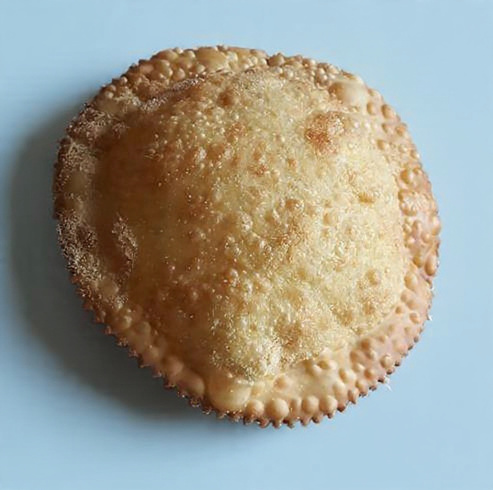
Seadas are a paradox. They are technically a dessert, but they taste like nothing so much as a conversation between savoury and sweet — a negotiation, really, between the sharp tang of fresh pecorino and the ancient, slightly medicinal bitterness of Sardinian miele amaro (corbezzolo honey, made from arbutus blossom).
My grandmother made them for special occasions only. Easter, Christmas, the feast of the village’s patron saint. The fact that you can now find them on the menu of nearly every restaurant in Cagliari, usually drenched in supermarket acacia honey, would have appalled her.
Use the right honey. Everything else is technique.
On the Honey
The traditional honey for seadas is corbezzolo (strawberry tree honey), which is harvested in autumn in Sardinia and Corsica. It is deeply bitter — almost medicinal — a counterpoint to the rich fried pastry that no sweet honey can replicate. If you cannot find it, use a strong, dark chestnut honey or millefiori. Never use acacia or clover honey — too sweet, too one-dimensional.
Corbezzolo honey can be ordered online from specialist Italian food shops.
On the Cheese
Use fresh pecorino sardo or fresh sheep’s milk ricotta. In some villages, the cheese is left to slightly acidify for 2–3 days before use — this gives it more character. If your fresh pecorino is very mild, add a squeeze of lemon juice and a pinch of lemon zest to the filling.
Ingredients
For the pastry
- 300g semola di grano duro rimacinata
- 100g plain (all-purpose) flour
- 60g lard or unsalted butter, softened (lard is traditional)
- 150ml warm water
- 1 tsp fine sea salt
For the filling
- 400g fresh Pecorino Sardo (or a mix of fresh sheep’s milk ricotta and a little grated aged Pecorino)
- Zest of 1 lemon (unwaxed)
- 1 tbsp caster sugar
To finish
- Sunflower or light olive oil for deep-frying (at least 1 litre)
- 4–6 tbsp corbezzolo honey (or strong chestnut honey)
Instructions
Make the pastry
- Combine the two flours and salt in a bowl. Rub in the lard until the mixture resembles fine breadcrumbs.
- Add warm water gradually, mixing until a smooth, pliable dough forms. It should not be sticky.
- Wrap in cling film and rest at room temperature for 30 minutes.
Make the filling
- If using fresh pecorino, grate it coarsely. Mix with lemon zest and sugar. If the cheese is very firm, warm it briefly in a pan over low heat until just beginning to melt, then cool slightly before using.
Assemble
- Roll the dough out very thin — about 2mm. Cut into circles approximately 12cm in diameter (use a large glass or pastry cutter).
- Place a generous tablespoon of filling on one disc, leaving a 1.5cm border. Lay a second disc on top and press the edges firmly to seal, working out any air pockets. Crimp the edges with a fork or pinch into a rope pattern.
Fry
- Heat oil to 175–180°C in a deep pan. The oil should be deep enough to submerge the seadas.
- Fry 2–3 at a time for approximately 3–4 minutes, turning once, until deep golden on both sides. The cheese inside will melt completely.
- Remove with a slotted spoon and drain on kitchen paper for 30 seconds only — serve immediately.
Finish and serve
- Plate the hot seadas and pour corbezzolo honey directly over them at the table. The honey should pool in the ridges and drip over the edges. Serve at once.
Seadas must be eaten immediately. They do not wait. They do not reheat. They are a commitment.
Notes
Lard vs. butter: Lard makes a shorter, more traditional pastry. Butter works and is more accessible. Do not use margarine.
Cheese freshness: Day-old or same-day fresh pecorino works best. If it’s too wet, drain it in a cheesecloth for an hour before using.
The right oil temperature: Too cool and the pastry absorbs oil and becomes greasy. Too hot and the outside colours before the cheese melts. A thermometer is worth using here.
Serving suggestion: A small glass of chilled Mirto liqueur alongside is deeply traditional. The bitter herbal notes echo the corbezzolo honey beautifully.