There is a moment — and every Sardinian knows it — when your grandmother calls you to the kitchen table and hands you a small disc of semola dough. She says nothing, just folds her fingers into that unmistakable motion: a pinch, a twist, a pleat. She makes it look effortless. It is not.
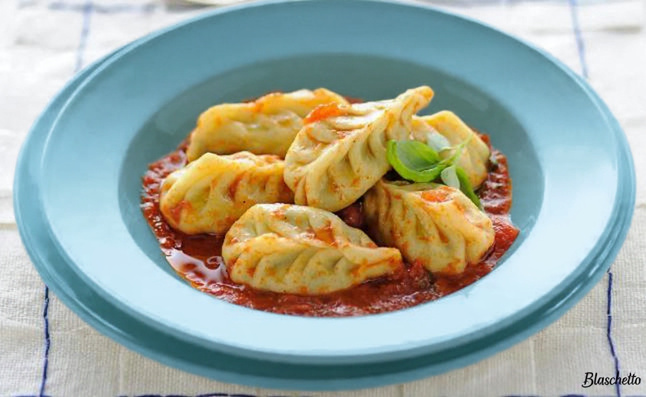
Culurgiones (pronounced koo-loo-JO-nes) are the stuffed pasta of Ogliastra, the ancient mountain province on Sardinia’s eastern coast. They are not ravioli. They are not pierogi. They are something entirely their own — sealed with a hand-pleated wheat-ear pattern called su spighitta that has been passed down, mother to daughter, for centuries.
The Filling That Defines a Region
The filling varies village by village, family by family — but the core is always the same: waxy potatoes mashed until smooth, aged Pecorino Sardo grated into the mix, a whisper of garlic (infused in olive oil, never raw), and the ingredient that makes Ogliastrino culurgiones unmistakable: fresh wild mint.
Do not substitute spearmint or peppermint. Wild mint (mentuccia in Italian, menta selvatica) has a gentler, more herbaceous bite. If you can’t find it, use a small amount of regular fresh mint combined with a pinch of fresh marjoram.
Ingredients
For the pasta dough
- 400g semola di grano duro rimacinata (finely milled durum wheat semolina)
- 200ml warm water
- 1 tsp fine sea salt
- 1 tbsp extra-virgin olive oil
For the filling
- 600g red-skinned potatoes (waxy variety), boiled in salted water
- 150g aged Pecorino Sardo, finely grated (or Pecorino Romano if unavailable)
- 2 cloves garlic, peeled and gently simmered in 3 tbsp olive oil for 5 minutes, then discarded
- A small handful of fresh wild mint (or fresh mint + pinch of marjoram), finely chopped
- Fine sea salt and white pepper to taste
To serve
- 200g simple tomato passata, warmed with a torn basil leaf
- Extra Pecorino Sardo for grating
- A drizzle of grassy Sardinian olive oil
Instructions
Make the dough
- Mound the semola on a clean work surface and form a well in the centre. Pour in the warm water gradually, working from the inside out. Add the salt and olive oil.
- Knead for 10–12 minutes until the dough is smooth, elastic, and slightly silky. It should spring back when you poke it. Cover with a damp cloth or wrap in cling film and rest at room temperature for at least 30 minutes.
Make the filling
- Drain the boiled potatoes and pass them through a potato ricer while still hot (do not use a food processor — this makes them gluey). Let cool to room temperature.
- Fold in the grated Pecorino, the garlic-infused olive oil, and the chopped mint. Season carefully with salt and white pepper. The filling should hold its shape when rolled into a ball.
Shape the culurgiones
- Divide the rested dough into four portions. Keep unused portions covered. Roll each portion out to about 2mm thickness.
- Cut circles approximately 8–9cm in diameter using a glass or pastry cutter.
- Place a generous teaspoon of filling in the centre of each circle. Fold the dough over into a half-moon, then begin the wheat-ear pleat: pinch the edge at one end and fold a small section of dough over from the right, then from the left, alternating in a tight zigzag down the entire seal. Press firmly. Each culurgione should have 12–15 pleats.
Tip: The pleating takes practice. Your first few will look nothing like your grandmother’s. Keep going. By the end of the batch, muscle memory starts to form.
Cook and serve
- Bring a large pot of generously salted water to a rolling boil. Drop the culurgiones in batches of 8–10. They will sink, then float. Cook for 3 minutes after they float.
- Remove with a slotted spoon and transfer directly into warmed tomato passata in a wide pan. Toss gently — never aggressively.
- Plate and finish with freshly grated Pecorino and a small drizzle of Sardinian olive oil.
Notes
Make-ahead: Culurgiones freeze beautifully. Lay them on a floured tray, freeze until solid, then transfer to bags. Cook from frozen — add 2 extra minutes.
Where to buy Pecorino Sardo: Look for the DOP-certified version at Italian delis or online at Gustiamo or Eataly. In a pinch, Pecorino Romano works, but use 20% less — it’s saltier.
On the pleating: There are YouTube videos of Sardinian nonnas demonstrating the technique. Watch them. Then ignore them. Then watch them again. It clicks eventually.
Authentic vs. adapted: In Ogliastra, culurgiones are served with the simplest possible tomato sauce — sometimes just stewed tomatoes with a drop of oil. Resist the urge to add complexity. The pasta is the star.