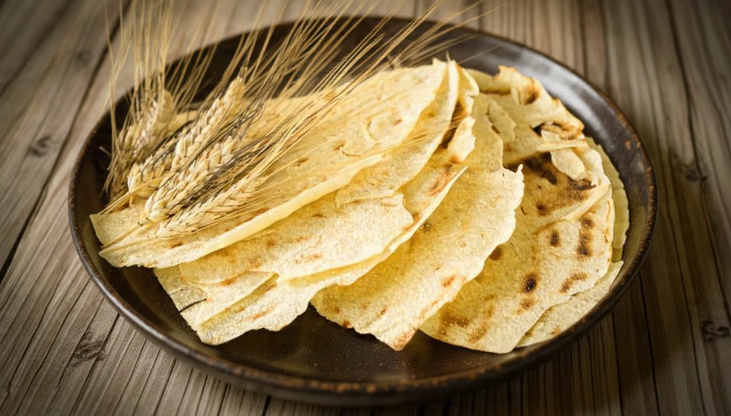
Pane carasau is older than written history. Archaeological evidence of it — charred fragments of paper-thin flatbread — has been found in Sardinian nuraghe settlements dating back 3,500 years. The Phoenicians knew it. The Romans knew it. Sardinian shepherds carried it up into the mountains of the Barbagia for months at a time, because it keeps for a year without going stale.
We call it carta da musica in Italian — music paper — because when you hold a fresh sheet up to the light, it’s nearly translucent, thin enough that you can almost read through it.
What It Actually Is
Pane carasau is a double-baked flatbread made from semola di grano duro. In its first bake, the thin disc puffs into a bubble. You pull it out, split it while hot into two paper-thin sheets, then return both sheets to the oven for the second bake (carasatura) which crisps them to a delicate snap.
The name itself comes from the Sardinian verb carasare — to toast, to char lightly. In a traditional Barbagia bakery, this second bake happens in a wood-fired stone oven. At home, a very hot conventional oven gets you 90% of the way there.
Ingredients
- 500g semola di grano duro rimacinata (finely milled durum wheat semolina)
- 300ml warm water (approximately — hydration varies by flour brand)
- 7g instant dried yeast (or 15g fresh yeast)
- 1½ tsp fine sea salt
Instructions
Make the dough
- Dissolve the yeast in 100ml of the warm water with a pinch of sugar. Leave for 5 minutes until foamy.
- In a large bowl, combine the semola and salt. Make a well, pour in the yeast mixture, then add remaining water gradually. Mix until a shaggy dough forms.
- Turn out and knead for 10 minutes until smooth and elastic. The dough will be stiffer than regular bread dough — this is correct.
- Place in a lightly oiled bowl, cover, and prove at room temperature for 1.5 to 2 hours until doubled.
Shape and first bake
- Preheat your oven as hot as it will go — ideally 280°C/550°F, or maximum setting. Place a baking steel or heavy baking sheet inside to heat.
- Divide the proved dough into 8 equal balls (approximately 100g each). Cover and rest for 15 minutes.
- On a lightly semola-dusted surface, roll each ball into a round as thin as you can make it — target 2mm or thinner. It should be nearly transparent in the thinner areas.
- Working quickly (do not let them dry out), bake the rounds directly on the hot steel one or two at a time for 3–4 minutes. Each disc will puff dramatically into a balloon — this is what you want.
- Remove immediately and set on a clean kitchen towel. While still very hot, carefully split each puffed balloon into two sheets by running a knife around the edge and pulling the two layers apart gently. They will tear if you let them cool.
Second bake — the carasatura
- Return the split sheets to the oven (as many as fit in a single layer) and bake for another 3–4 minutes until golden and completely crisp. Watch carefully — they go from golden to burnt in seconds at this temperature.
- Cool on a wire rack. They will crisp up further as they cool.
Serving
Guttiau: The most traditional way — brush a sheet of pane carasau with good olive oil and a pinch of sea salt, then return to a hot oven for 60 seconds. Serve immediately.
Pane frattau: A proper Sardinian peasant dish — soak sheets briefly in hot meat broth until just softened (not soggy), layer with tomato sauce and Pecorino, top with a poached egg.
As an aperitivo: Break into rough shards and serve alongside bottarga-butter, olive tapenade, or aged sheep’s milk cheese with honey.
Storage
Once fully cooled and crisp, store in an airtight tin or large zip-lock bag. Properly dried, it keeps for 2–3 weeks at room temperature — and in the Barbagia shepherds’ tradition, much, much longer.
Notes
Humidity is the enemy. If your pane carasau softens after a day or two, it hasn’t been baked long enough in the second phase. Return the sheets to a 200°C oven for 3–4 minutes to re-crisp.
Rolling: A long thin rolling pin is helpful. In Sardinia, a special wooden rod (cannellino) is used. A French-style rolling pin (no handles) gives you more control over even thinness.
Semolina vs. semola: Ensure you use the rimacinata (twice-milled) version, not coarse polenta-style semolina. The flour should be pale yellow and very fine.